
Okay, I needed a comedic break from the narrative that is the “news.” So, I watched the “fun” version on cable when Comedian Jimmy Failla summarized in a most serious tone, “We’re living in the death of shame.” Or in the words of Bishop Robert Fastiggi,
“Perhaps the greatest sin in the world today is that men have begun to lose the sense of sin.”
The metaphor that someone is “coming out” used to imply a degree of secrecy or privacy associated with one’s activity or life-style. Perhaps, in someway, we all had a closet experience, that secret side of our desires that we would never mention in public. Who wasn’t used to living two different lives, one real and covered up and the other what society expected of us! Dad used to say, “When in Rome live as the Romans do.” “Dance to the tune being played” even clumsily or even if you’d rather sit this one out.
The stress of living in two different worlds, one culturally acceptable and the other who you really are, has become, most understandably, a chain of a tyrannizing hypocrisy. That metaphorical “closet” now (as I see Mr. Failla’s interjection) has been dismantled social brick by brick, shame by shame, until in the name of a social honesty modern life has been transformed into a civilization that no longer identifies with “sin.” And no sin means to need of a Savior… sadly.
Not everything one does in private or secret is sinful… Please! But, what we are saying is that, no one can live their entire life as the free exercise of their passions, if it isn’t natural, if it does not put on display their real self. There is no bigger lie than trying to convince yourself that some culture you find yourself in must know better than you what is in your best interest, to pretend to love what you detest, to publicly smile through private tears.
But “shame” is still a real thing, a really word, in our Bible. Actually, there is more than one word because there is more than one kind of shame. Shame can be the fear of being discovered, the fear of being disapproved by the social circle we move in. As Jeremiah 2:26 reminds us, “disgraced when … caught….”
But there is a Biblical word for shame meaning a reverence for the good as good. When this good is not honored in one’s actions, the sense of shame, like a faithful conscience, sounds the alarm. This has nothing to do with reputation. It has to do with honor—and to God that means “reverence.”
“…serve God acceptably with reverence” Hebrews 12:28
Scholarship tells us, “We may say that [a godly reverence] restrains a good man from an unworthy act, while [being found out] would sometimes restrain a bad one.” Shame is a friend if it can forewarn, but we live now in social change that prefers to disconnect altogether from any moral code God might be said to have inspired. Thinking this way, it seems best to destroy shame in social change (make it not against any moral law by getting rid of all talk of God). I leave it to honest faith to recognize the danger here.
There is a third term in our Bible which includes self-introspection. You, who know God because you walk with Him, should always see if the Spirit within, in whom you confide, would tell you that what you about to do or say, or where you are about to go, is out of character with the new you. Be advised!
Paul said it best:
Rather, we have renounced secret and shameful ways; we do not use deception, nor do we distort the word of God. On the contrary, by setting forth the truth plainly we commend ourselves to everyone’s conscience in the sight of God. – 2 Corinthians 4:2
 3. The third plague was (perhaps) a species of mosquito native to Egypt. Some say, the gnat or a flea or lice—something that attacks both man and beast. The magicians called this “the finger of God” [Exodus 8:19].
 I am reading Schweizer’s work, “Red-Handed” which highlights the effort of people in power (both sides of the isle) to get—not rich but— richer. It represents the biblical idea of “greed’ which Paul called a form of idol worship (Colossians 3:5). Paul called it an ‘impassioned evil’. The Greek word, according to scholarship, designates “the fiercer and ever fiercer longing of the creature which has forsaken God, to fill itself with the lower objects of sense.” Trench calls it “the monsters of lust” [Trench, “Synonyms” pg. 83]. Cicero called it a “rapacious avarice” [Pro Coel. 6].
 There is no shame in trusting God for all our needs; in fact, it is the circumstance of the blessed! The last thing any believer should want is a winning lottery ticket which brings with it a multitude of woes! The last thing we want is to discard our Lord’s interest in our lives for the pursuit of temporary pleasures.
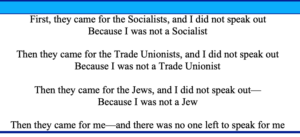 Are we here again? The first amendment rights are being circumvented, as Rachel Campus-Duffy on Fox & Friends compared it, “like Nazi Germany.” “It’s the biggest story you’re not hearing about,” she disclosed. Whereas she was more focused on political rights, there can be no rights at all if our worship of God is in any way impinged upon or diminished. Like Pete Hegseth on the Sunday Fox & Friends reminds us, “Go to church!”
 impulses,” Hockenos explained, “in Catholicism he [Niemöller] found ‘the living incarnate Word of God.’” Many thought this Lutheran pillar of the Faith was converting to Catholicism but that wasn’t the point.
 It was time for a career change. It seemed a serious education in what is written in God’s Word and an open inquiry into its value threatened denominational autonomy. It seemed that doctrines explained, beyond what was necessary to keep parishioners faithfully coming, posed a quintessential challenge to the church’s very existence. Don’t mention glossolalia in a Baptist church or explain Martin Luther’s fears that led him to a “faith without works” belief. Don’t give a serious rationale to the “confessional” to a non-catholic.
 The church—any church, every church—needs teachers to educate God’s people in the clear, simple, and emphatic message of scripture: in Jesus’ Sermon on the Mount, in the witness of an Ezekiel and the outcry of the rich man from the beyond to send someone to tell his brothers how wrong he was. We need teachers that are not afraid to step on a few theological toes for the sake of a genuine faith, a living faith, stirred to life within each listener. We need teachers that are not puppets of pet ideas or visionaries of personal achievements, but who will humbly let the Spirit of God do His thing among His people. We need teachers that are less scholars of finance and more scholars of Divine truth, that are willing to sacrifice their own reputations and lives for the same message Jesus sacrificed His!
 nuances a word differently from how we are prone to interpret it. Preachers often translate Scriptural thoughts in a way slanted to make more sense to the occidental mind, to the way we think or understand things, even though most Scripture was written to the oriental or (semitic) thinker.
 I can begin to see way the translators might like the word “promises” I will leave you to look up the rest. In each case the English word “promise” interprets the Hebrew word “Word” which in the Greek is the well known theological term “logos.” We know the “Logos” of God is Jesus Himself (John 1:1)! Think about it.