Isaiah 53 is an incredible prophecy—by his own admission in verse 1—which cannot be discarded as uninspired or not revelatory without at the same time a total disregard for the honest and reasonable explanation a simple reading of the text offers. It is prophetic insight into a divine plan to offer Jesus for the sins of mankind.It is a prophecy that could not be explained until we were able to look back in history and see for ourselves that it happened as Isaiah described.1 One is disingenuouswho expresses a disinterest in this chapter because it fails to support a hoped for corroboration with evolutionary or new-orthodox theory.To conclude, therefore, that Isaiah’s “Suffering Servant” cannot be Jesus, or that chapter 53 does not specifically reference his vicarious and sacrificial death, is to shut the mind’s eye to an obvious truth that like a blinding sun outshines the logic of other interpretations.
Philip and the Ethiopian
Philip didn’t have John 3:16 or Acts 16:4 or Romans 3:23-25 to discuss God’s salvation through Christ …but he had Isaiah.And he had a translation not any original Hebrew.Ethiopians were fluent in Greek not Hebrew and they had the Septuagint version, the Greek translation, of Isaiah’s “Gospel.” The Ethiopian eunuch, whom Philip met in the wilderness, was reading it which was Philip’s opportunity to explain Calvary. Should we need any more to convince us of the providential hand of God, the irrefutableevidence, that confirms and validates a christian faith in Isaiah’s work as the Word of God!?
And if it is God’s Word, we have been given one more miracle of the visible reality of an immanent God of Love.Here in this simple account of 2 men in a chariot discussing the message of the Suffering Servant are seen the two biggest miracles:Salvation has come to this Eunuch who was a Gentile, not a Jew, and the miracle of that book that he held in his hand over half a millenium after the prophet first transcribed it.
1 Luke 9:44-45 “Listen carefully to what I am about to tell you: The Son of Man is going to be delivered into the hands of men.” But they did not understand what this meant. It was hidden from them, so that they did not grasp it, and they were afraid to ask him about it.
Psalms 112:5 came to my attention recently when a friend and I muddled through some ideas that seemed to suggest its meaning.
A good man sheweth favour, and lendeth: he will guide his affairs with discretion. – KJV
It is generally agreed now that “discretion” is a poor translation. So, we look at others:
Good will come to those who are generous and lend freely, who conduct their affairs with justice. – NIV
Good is the man — gracious and lending, He sustaineth his matters in judgment. – Young’s Literal Translation
The word “lend” is correct but does not suggest a means for making money, since, usury or interest did not gain favor with God. [Exodus 22:25]. “Gracious” or “generous” are good words. The original suggests a charitable and compassionate spirit of giving. [Matthew 5:7]
It is the second half of the verse that puzzles me: “who conduct their affairs with justice.” Another rendering worthy our attention comes from a Hebrew lexicon on the word “conduct.” It more correctly signifies to sustain, support or endure: “He will sustain a cause in court.”
We are thinking that the “he” here is not God but the fellow who lives by this principle of giving to the poor. He will discover that his way of living supports him in turn when his hour of need comes. The idea here might be that a giving heart is a wise motivator while conducting our own affairs. When greed dominates our interests, we are heading toward an inevitable crash and burn scenario.
Also: even though the idea is good theology, the word “judgment,” here, I don’t believe means divine or final judgment. The merciful in this life will in turn receive mercy from God in the next, but, I want to think that somehow the Psalmist is saying that a giving spirit will support us in ways we have yet to imagine. There is an unseen wisdom in giving. Charity is an investment in our own lives worth considering!
I lean toward a free translation which might read something like this:
A good man lives by this principle: he is a charitable giver and will lend to the poor. A giving spirit is a fair spirit, a fairness in his dealings that governs his life and sustains him.
Verses 6 & 7 add: He will not discard this way of life in times of panic; he does not fear bad news. He has learned to trust God.
The best answer to our own need is addressing the needs of others. [2 Corinthians 8:2].
The best way to be prepared for fearful times—that seem to find us all—is to live ….charitably. [Proverbs 14:21; 19:17]
Learning to trust God is not an exercise in academia. It is an exercise in giving. [Psalm 18:25; Proverbs 14:31]
A generous spirit, reaching out to help another, is an exercise in faith that does not react to fear. [Proverbs 21:13; 22:9]
The Message translation reads “…Sunrise breaks through the darkness for good people— God’s grace and mercy and justice!”
There are many reasons for believing in God. Our reasons may be as individual as each one’s christian experience or as collectively appreciated as a scriptural promise that is shared by many or all believers. I have searched to understand the Presence of God, first and foremost, in the dynamic of an inner peace that often contradicts my circumstances. But no less meaningful to me for a probably less recognized reason: the miracle of holding a Bible in my hand and meditating on the possibility of my not having such a cherished treasure if there had not been a loving God to get it to me. There are so many finer points to make to corroborate this statement in the study of the Bible, its language, its message, its focus, that support a divine authorship—not to minimize the simple miracle of having it to hold, thirteen hundred plus years in the making while God employed dozens of amanuenses to script it.
But there is another that has my attention, and I wish I could play journalist for a week and interview a few hundred believers to ask them—and here it is straight:
“Why do you lift your hand or hands during a song service?”
I have seen Baptists, Presbyterians, Catholics, among others, …and, of course, Pentecostals do it. But do they know they have this strange ritual in common? Maybe it is not so strange. Maybe it is not a ritual! No one is told to do it and the people who do—well—seem to be “in a worshipful moment” as if only God and they were in the room. Their eyes are closed. They may have tears visible. Most observable is the expression on their faces that seems to brighten their countenance—a kind of unplanned beauty or glow about them. Some describe this as being shut in with God.
For God, who said, “Let light shine out of darkness,” made his light shine in our hearts to give us the light of the knowledge of God’s glory displayed in the face of Christ. 2 Corinthians 4:6
There is a biblical word for this
Here’s the interesting part in all this: There is a biblical word for this as if God were choreographing some ceremonial expression designed exclusively to honor Him. After all the scripture affirms: God inhabits the “praises” of His people [Psalms 22:3] … and (ready for this?!) the verb in the Old Testament for praise comes from the word “hand” and means—among other related nuances—to show or point out with the hand extended, to celebrate and give thanks [an exclamation point …or two… belongs here]!!
But you are a chosen people, a royal priesthood, a holy nation, God’s special possession, that you may declare the praises of him who called you out of darkness into his wonderful light. 1 Peter 2:9
The Psalmist averred as much when he wrote:
I lift up my hands toward your Most Holy Place. Psalm 28:2
Recall Paul admonishing young Timothy’s congregants:
Therefore I want the men everywhere to pray, lifting up holy hands without anger or disputing. 1 Timothy 2:8
The simple truth is that the uplifted hand is the universal symbol of praising God.
A universal expression of individual worship
Oh yes, Pentecostals often instruct their parishioners to raise their hands in worship but no one is telling the Baptists or Presbyterians or Catholics to do this. I think they wouldn’t dare because such a free flow of expression might not be as natural in these services where the order of the ritual is—I say lovingly—by design, more a part of the worship.
But without being told to, hands go up before God with a spontaneous, almost intuitive, longing to display the heart’s devotion to Him. It is as if one’s hands were begging the believer to permit them this declaration of praise. And so often the worshipper seems to raise hands in worship without thought or intention other than it “feels” right. One’s arms seems to almost raise themselves as if to say to the worshipper, “Allow me this joy!”
This appears to be a universal expression of worship, the one declaration of a heart after God’s own heart shared by all believers, the one ritual no man or church can claim as their own. Christians are not honoring some ritual or some theology or some worship leader’s call to worship; they are honoring God in this most basic and humble expression of their love for Him.
What more proof need we that God is real among His people?!
Sometimes a need to confirm a theological point of view hides a scriptural message that ought to be evident within the sacred text. Remember Jonah? …who according to his own testimony was 3 days in the “womb of the grave” [Jonah 2:2] which the NIV translated in a poetic line: “deep in the realm of the dead.” He was buried alive! Just say it! Then we might linger a moment in silence before launching into an obtuse opprobrium about Jonah’s disobedience, lack of faith, and unexplained prejudiced hostility toward the Ninevites, whom God mercifully sought to pardon.
Jonah was buried alive!! …and spend three horrifying days in a nightmare he could not wake up from: the smelly, stale air confines of a beast, a great fish, that probably was tossing him, metaphorically speaking, from roof to floor and side to side. Atheism dismisses this as pure fable because we know of no such leviathan, although, we are told that 99% of all species that ever existed are now extinct.1
The point of this very human story is being missed by these two exegetical extremes, because the real story traces the emotional turmoil of a prophet who had every sign of PTSD.2 The account, using a Hebrew word for “evil,” simply says that Jonah was heavily distressed, overwhelmingly miserable, and enraged.
…at God? You decide, but I don’t think the outward target of his rage is important. [Jonah 4:1]. Often we misdirect our anger when in pain. The Greek [LXX] is the best translation: Jonah was in great pain—an emotional pain along with a pronounced physical discomfort.
The KJV says “displeased.” Displeased is what I feel when a five year old son spills a glass of milk because he was fussing instead of eating his lunch. “Displeased” doesn’t fit the moment you awaken by some miracle of God after having been Buried Alive!
After Jonah delivered God’s message, he retired east of town where his thoughts turned suicidal. [Jonah 4:3]. The Greek translation, again, is picturesque: Jonah was in great pain.
We are sadly too anxious to discuss God’s mercy toward the Gentiles to be too concerned about the experience of this wayward prophet, who—okay—was stupid to run from God. I get it. I get it: our theological interest in grace. …until it’s …me we’re talking about! Then I don’t want to talk about people I think deserve something other than divine mercy while I’m imploding.
I like the last few verses in this prophecy in which God, being the God that He is, provides His servant, confused, perhaps, and hurting, with temporary shade that momentarily soothes his anxious spirit and gives him pause from all that has recently gone wrong in his life. …and then God asks, “Jonah, tell me what angers you so? Tell me all about it, son.” [Jonah 4:4-8]
God knew. God always knows! Then God gently redirects Jonah’s thoughts forward to a merciful tomorrow, toward a time when God will be able to love even Ninevites. [Jonah 4:10-11]
If I’m on to something here, Jonah’s prejudice toward Nineveh, thanks to a storm and a fish, was no longer the center of the prophet’s attention. He simply needed God. He needed God’s touch on His own life which—I surmise—gave Jonah an altered perspective on a God Whose love cannot be exhausted on Israel or the tribe of Zebulon or the town of Gathhepher from where Jonah hailed. [2Ki 14:25]
And was God cruel for using something as tortuous as a three day ride in a “prepared fish” [Jonah 1:17]—even if the Creator had His Son on His mind at the time!
For as Jonah was three days and three nights in the belly of a huge fish, so the Son of Man will be three days and three nights in the heart of the earth. – Matthew 12:40
I won’t argue a response because life is riddled with misadventure and pain for every believer and an answer for Jonah has to work for all of us—don’t you think? The straight truth is the such circumstances somehow provide God with far more visibility in our lives. Somehow faith is purified in fire. [I Peter 1:7] ..and God does heal!
All I know is that the story begins with God’s servant running from Him and ends with this same servant talking to Him in meaningful prayer and communion.
1More than 99 percent of all species, amounting to over five billion species, that ever lived on Earth are estimated to have died out. Estimates on the number of Earth’s current species range from 10 million to 14 million, of which about 1.2 million have been documented and over 86 percent have not yet been described. Wiki
[Taken from my newest pamphlet: Understanding God: The Problem With Grace]
The first missionary ever to leave the comforts of familiar surroundings and loving companions was God Himself in the person of His Son.The language barrier should not be ignored as an incidental difference.
Moffat in his “Missionary Labors and Scenes in South Africa” gives us a very remarkable example of the disappearing of one of the most significant words from the language … the disappearing as well of the great spiritual …truth whereof that word was at once the vehicle and the guardian.
The Bechuanas … employed formerly the word ’Morimo,’ to designate ’Him that is above,’ or ’Him that is in Heaven,” and attached to the word the notion of a supreme Divine Being… Thus is it the ever repeated complaint of the Missionary that the very terms are well nigh or wholly wanting in the dialect … whereby to impart to him heavenly truths, or indeed even the nobler emotions of the human heart.1
In the person of His Son, Jesus, God learned our language through much hardship2 because language is more than words, it is culture and ideology down to the very pondering of the human heart.Jesus faced a paganism in all of us, a darkness,when He came to our world that had nothing in common with the one He left. When He gave up the comforts of the Kingdom from which He came3 the Prince of Heaven lay aside the royal robes of such a glorious place and donned a beggar’s garb.He was unrecognized and unwelcome but He was God’s ambassador, God’s first missionary; so, He learned to live among us.He experienced the pain and joylessness of a spiritual poverty we were unaware of because we came to accept our world for what it was, not knowing there was another.
So the burden of God became the task of sharing His world with us in the language of young children, a language of expression and feeling, a non-technical language that must not try—because it could not—to describe or represent the glories of God’s heaven, God’s eternity, the infinite resources of His grace.It was enough that we might imagine these things and trust Him to explain more later.It was enough that He began to give us a child’s vision of love.4It was enough that we had reason again to hope.5It was enough that He gave us glimpses of possibilities beyond our impoverished condition.6The details of “golden streets” and angelic assemblies in praise will have to wait, meanwhile we imagine what it will be like. Don’t be too surprised if it turns out better!
It is our Bible that tells the story of God’s missionary journey among us in words that appear common but as Professor Trench reminds us:
“…words often contain a witness for great moral truths—God having impressed such a seal of truth upon language, that men are continually uttering deeper things than they know…”7
So Jesus began to share on the fringe of an infinite benevolence by healing the sick and raising the dead, but the crowds of followers didn’t get it.Only a handful of followers, ignorant still in so many details, knew in their spirit that they should not forsake Him.8
We, too, long for the fuller revelation of what is meant by grace and the benefits of heaven. The words we now cherish in our theologies and the preachers’ sermon notes are indeed the language of children, the early embrace of a God whose love in full awaits that eternal day.
1 Richard C. Trench Synonyms of the New Testament pg 197 2 Hebrews 5:8 Son though he was, he learned obedience from what he suffered 3 Philippians 2:7 he made himself nothing 4 Luke 18:17 Truly I tell you, anyone who will not receive the kingdom of God like a little child will never enter it. 5 Jeremiah 29:11 “For I know the plans I have for you,” declares the LORD, “plans to prosper you and not to harm you, plans to give you hope and a future. 6 2 Corinthians 5:5 Now the one who has fashioned us for this very purpose is God, who has given us the Spirit as a deposit, guaranteeing what is to come. 7 Richard C. Trench. On the Study of the Words Lectures. 8 John 6:68 Then Simon Peter answered him, Lord, to whom shall we go? thou hast the words of eternal life.
[Taken from my newest pamphlet: Understanding God: The Problem With Grace]
John Reuchlin, (d. 1522), who was the father of Hebrew philology among Christians, in determining the Old Testament Canon adhered almost entirely to Jewish tradition. But the field of investigating the Hebrew language widened gradually in the seventeenth century to include cognate or kindred languages changing scholarship’s understanding of the origin and authenticity of the canon. A fuller study of the historical evolution of Hebrew came in the 1800’s when the linguistic phenomena could be more fully described. Scholars of the day explained the organic connexion (the historical-critical method) of these phenomena in Hebrew by comparison with sister languages: Sanskrit, Arabic, Ugaritic, Aramaic, and other semitic languages, and by employing the general rules of philology which by then had joined the sciences in linguistic research.Two observations were made.
First, The Hebrew language fell into 2 periods: The earlier period before the Babylonian exile and the second after the exile. The Old Testament writings (by and large) belonged to this second period. This scholarly conclusion has become a contentious issue with the fundamental belief in a verbal plenary theory of divine inspiration. How can “every word” be from God when the text dates grammatically hundreds of years after the supposed writers of it.
Another academic blow fell when such observations more and more led to the belief that the original text (wherever it is) has suffered to a much greater extent than formerly admitted by biblical scholarship. There appear unintentional corruptions in copying the text: the interchange of similar letters; transpositions and omissions of letter, words, even entire sentences because the copyist’s eye fell or the missing piece was reinserted in the wrong place because one’s eye lost its place in copying.1 Simply said, the scribe’s eye would wander. This led to erroneous repetitions and misspellings that might represent a different thought. All of this became the work of the “textual” critic to observe in an effort to ascertain, if possible, what was originally written.2 Gesenius, in his grammar, informs us:
“The beginning of …Hebrew literature generally is undoubtedly to be placed as early as the time of Moses, although the Pentateuch [Moses’ writing] in its present form, in which very different strata may be still clearly recognized, is to be regarded as a gradual production of the centuries after Moses.”3
But the critic gave no thought now to divine authorship. Elihu’s comment, offered as a comfort to his friend, Job, has fallen in recent times on deaf ears: [It is] the breath of the Almighty, that gives them understanding.4 Paul’s encouraging thought also no longer drives the interest of the seminarian:
All Scripture is God-breathed and is useful for teaching, rebuking, correcting and training in righteousness,5
Perhaps, we need to determine what Scripture is in the “all” or perhaps, the theory that every word is to be considered divinely handwritten needs tweaking. Or perhaps, we need to simply recognize that just having the Bible is the miracle and we need not question the course divine providence took to get it to us. Our focus needs to remain on the message not the philological changes that have not—because they could not—destroy the message of grace contained within its pages. To us, it is and remains the Word of God, not because it is scientifically verifiable nor because we have to blindly assume the text must be grammatically and syntactically perfect. Just because somehow the language (or the oral traditions) of Moses might have been toyed with in the wording or translated into a more current version of the Hebrew language, post-exile, should not shake faith. The message is intact.
The fact that some ancient script which might have been closer to what Moses might have chiseled in stone or scratch on vellum or penned on papyrus came to us changed linguistically should be incidental to our interest in studying the message itself. Let each reader decide for themselves whether or not what he or she is reading is God inspired.
As christians we have been accused of having a cognitive dissonance when it comes to the Bible. We seem naively to endorse the text in our spoken language trusting the translation to provide the inspiration …and rightly so! It is called “faith.” And we live by that. Over the course of decades of studying and teaching this sacred work, I have read nothing that gave me pause to doubt my faith.
….And I am not alone.
1 Consider Isaiah 2:2 written pre-exile and Micah 4:1 written post. Is it possible that whoever wrote Micah penned these words in Isaiah?
Isa 2:2 In the last days the mountain of the LORD’s temple will be established as the highest of the mountains; it will be exalted above the hills, and all nations will stream to it.
Micah 4:1 In the last days the mountain of the LORD’s temple will be established as the highest of the mountains; it will be exalted above the hills, and peoples will stream to it. 2 see Kautzsch. Introduction 3 Kautszsch. Introduction. 13 n
What Gesenius is observing, for example, is the use of certain archaic words of epicene use (a masculine form for both genders), a “boy” also used for a girl or one pronoun used for both genders. Now the critics see this as a later redaction. Deuteronomy 22:15 “the young woman” is written about a girl but says “boy”. 4 Job 32:8 5 2 Timothy 3:16
Many young adults who once frequented church have now lost trust in the God Who redeems. They no longer believe the Easter story, Christ’s Resurrection. They have found the logic of the modern skeptic more reasonable sounding even after years of attending Sunday School and being raised on this sacred belief. What angers me to tears is that the arguments to discredit the resurrection account have no more validity or evidence going for them than the prefabbed story of Easter bunnies delivering chocolate to children. But because the natural mind cannot fathom the idea of a God Who can do miraculous things, the skeptic’s story, built of the selective details from various ancient authors and held together by dreamt up hypotheses, appears intellectually solid in construction. It is a “house of cards” …and they have our youth believing in it. And I’m tearful and angry!
Our most sacred and cherished faith in our Redeemer God and Savior Jesus Christ is not an offshoot of some ancient myth, even though this sounds sensible to young, impressionable minds. Bart Ehrman, a New Testament scholar and textual critic turned agnostic, blogged
Resurrection was, … part and parcel of ancient Zoroastrian thought [Persian]. …Israel had been for a time subject to the Persian Empire, for about two centuries… from the time Persia defeated the Babylonians … Therefore it makes best sense, by this logic, to think that Jews got the idea of a future resurrection from the Persians. Hey, they had to get it from somewhere, right?1
“They had to get it from somewhere.” He got that right! But the Persians didn’t imagine the idea of bodily resurrection of a Savior who had been crucified. That idea is provably from GOD! I use the same reasoning: “They [the apostles] had to get it from somewhere.” And it didn’t come through the evolutionary process. There is no connection between what happened on Calvary followed by Christ’s resurrection and any religious meme!
Yes, ancient religions maintained that a war between good and evil was afoot. And scholarship correctly finds similarities between myth and christian teaching. But the trick is to get the unwary religious traveler to presuppose that an idea, like the vicarious atonement, came through ancient religious thought even though mythology did not have an inkling of this blessed truth.
Payam Nabarz, a Persian-born Sufi and practicing Dervish, concluded,
“The Zoroastrian dualistic idea of Good versus Evil was inherited by Judaism and then Christianity; indeed, it is possible to trace the axis of evil-versus-good theology and mentality from Zoroaster to all the current monotheistic world religions.”2
“Mentality!?” Some theology is similar but how dare you confuse my faith in a Savior with a paganism that never came close to understanding even the possibility of such a salvation. The conflict of the ages between good and evil was fought and won by our Savior on that cross! [an idea that is only developed in Scripture.]
Franz Cumont,3 an insightful scholar of the ancient Persian religions, shows—and we concede the point—that Persian influence was everywhere in evidence in Roman religious thought:
Mithraism in the West was Romanized Mazdaism, thus still at its core a Persian religion….4
Payam Nabarz tells the same, that ancient Persian religious thought and myth made its way up through time in a kind of religious evolution into the Christian era. [Incidentally, the idea of religious evolution is unprovable but sounds reasonable if you believe in the biological version.]
“Mithra is an ancient Indo-Iranian god who was worshipped in polytheistic Persia at least as early as the second millennium B.C.E., … The myths of this ancient god contain elements that link him with the mythologies of all the Indo-European peoples.”5
And we must admit if we are intellectually honest that Persian mythology tainted much of the religious thinking during the early days of Christianity. [This footnote tells the story]6
But here’s where we look closer! Cumont concluded, though,
“We cannot presume to unravel today a question which divided contemporaries and which shall doubtless forever remain insoluble. We are too imperfectly acquainted with the dogmas and liturgies of Roman Mazdaism, as well as with the development of primitive Christianity, to say definitely what mutual influences were operative in their simultaneous evolution. But be this as it may, resemblances do not necessarily suppose an imitation.7
What Mazdaism (the Roman version of the Persian religions) did not have—and for the matter no dogma or religion outside christianity had—was the Cross of a Redeemer, a vicarious atonement. As Dr. Gregory Boyd, a professor at Bethel College, St. Paul, Minnesota, wrote:
“There is no other belief which does this… Only the Gospel dares to proclaim that God enters smack-dab into the middle of the hell we created. Only the Gospel dares to proclaim that God was born a baby in a bloody, crap-filled stable, that He lived a life befriending the prostitutes and lepers no one else would befriend, and that He suffered firsthand, the hellish depth of all that is nightmarish in human existence.”8
In the words of Franz Cumont:
“It was a strong source of inferiority for Mazdaism that it believed in only a mythical redeemer. That unfailing wellspring of religious emotion supplied by the teachings and the passion of the God sacrificed on the cross, never flowed for the disciples of Mithra.”9
“…the God sacrificed on the cross, never flowed for the disciples of Mithra [Ancient Perisan religions].” In Zoroastrianism, an offshoot of Mithraism or Mazdaism, salvation was linked to the sacrifice of a bull!
A savior figure, Sošyant, will sacrifice a bull from whose fat, mixed with hôm, the drink of corporal immortality will be prepared.10
As we know through Paul’s writings, the Resurrection of Christ is an essential part of the divine plan of salvation.
But if it is preached that Christ has been raised from the dead, how can some of you say that there is no resurrection of the dead?If there is no resurrection of the dead, then not even Christ has been raised. And if Christ has not been raised, our preaching is useless and so is your faith. – I Corinthians 15:12-14
Beyond the academic inquiry into our Savior’s death and resurrection, one cannot give their life to Christ and say, in all clear conscience, nothing happened.
Jesus, we maintain, was totally God and totally man. [Philippians 2:6-8] The profound thought here: if Jesus is God, then when Jesus died, God died for the sins of all mankind. [I John 2:2] And if Jesus is totally man, then when He was raised again from the dead, man was resurrected. [I Corinthians 15:20]
Lord, open eyes to see truth!!!
1 https://ehrmanblog.org/was-resurrection-a-zoroastrian-idea/ 2 Payam Nabarz. The Mysteries of Mithras: The Pagan Belief That Shaped the Christian World (Rochester,VT: Inner Traditions/Bear & Company. 2005), (Kindle Locations 214-216). 3 Franz-Valéry-Marie Cumont a Belgian archaeologist and historian, a philologist and student of epigraphy, who brought these often isolated specialties to bear on the syncretic mystery religions of Late Antiquity, notably Mithraism. 4 http://www.iranicaonline.org/articles/mithraism 5 Payam Nabarz. The Mysteries of Mithras: The Pagan Belief That Shaped the Christian World (Rochester,VT: Inner Traditions/Bear & Company. 2005), (Kindle Locations 185-193). “…the Vedic Mitra (Indian) and the Iranian Mithra (Perisan) have preserved so many traits of resemblance that it is impossible to entertain any doubt concerning their common origin. Both religions saw in him a god of light, invoked together with Heaven, bearing in the one case the name of Varuna (Hinduism) and in the other that of Ahura (Perisan Mithraism); in ethics he was recognized as the protector of truth, the antagonist of falsehood and error.” – Franz Cumont . THE MYSTERIES OF MITHRA p 2. Kindle Edition.
6Later on we see that the Christians adopted the twenty-fifth of December as Christ’s birthday, in the fourth century of the Common Era, according to Sir James G. Frazer. In The Golden Bough, he writes of . . . the festival of Christmas, which the church seems to have borrowed directly from its heathen rival. — Ibid. Kindle Locations 947-950).
The rites which they practiced offered numerous analogies.The sectaries of the Persian god, like the Christians:
purified themselves by baptism;
received, by a species of confirmation, the power necessary to combat the spirits of evil; and
expected from a Lord’s Supper salvation of body and soul. Like the latter,
they also held Sunday sacred, and
celebrated the birth of the Sun on the 25th of December, the same day on which Christmas has been celebrated, since the fourth century at least.
They both preached a categorical system of ethics,
regarded asceticism as meritorious, and
counted among their principal virtues abstinence and continence, renunciation and self-control.
Their conceptions of the world and of the destiny of man were similar.
They both admitted the existence of a Heaven inhabited by beatified ones, situate in the upper regions, and
of a Hell peopled by demons, situate in the bowels of the earth.
They both placed a Flood at the beginning of history;
they both assigned as the source of their traditions a primitive revelation;
they both, finally, believed in the immortality of the soul, in a last judgment, and in a resurrection of the dead, consequent upon a final conflagration of the universe.
We have seen that the theology of the Mysteries made of Mithra a “mediator” equivalent to the Alexandrian Logos. Like him, Christ also was a μεσίτης, an intermediary between his celestial father and men — Franz Cumont (2011-07-12). THE MYSTERIES OF MITHRA. Pp. 191ff. 7 Cumont noted [THE MYSTERIES OF MITHRA p. 195f.] 8 Boyd, Gregory A. Letters From A Skeptic (Colorado Springs, CO: Cook Communication Ministries, 2004), 151. 9 Franz Cumont. THE MYSTERIES OF MITHRA. p. 196. Kindle Edition. 10 http://www.iranicaonline.org/articles/mithraism
Eternity in the biblical world was the idea of “duration.” Scholarship tells us that in the Old Testament there are ten different terms marking duration.1Some concepts are admittedly difficult to discuss intelligently.Discussing Eternity, we are like someone who has never left the house discussing what it’s like to be in a busy market place.We are naturalists and people of this earth talking about heaven.Paul said it right:
And I know that this man—whether in the body or apart from the body I do not know, but God knows—was caught up to paradise and heard inexpressible things, things that no one is permitted to tell.2
And again He affirms that there is a spiritual dimension, another world, which we often reference as believers and which our faith is invested in, that the natural mind—something we all have—is unable to explain.The two realms are mutually exclusive worlds.3
“There is no solution of the problem, however” writes Bowman,4 “but only a dismissal of the problem of infinity;5 according to [Immanuel] Kant6 all experience is finite, and so infinity does not belong within the range of our experience.”
Max Mueller, a British philologist, wrote,7
“The infinite is hidden from the senses, …denied by Reason, but … perceived by Faith.”
Faith, for the believer in Christ, introduces them to this spiritual world. Faith is not just a belief but an awareness, a real introduction into our first acquaintance in this life with heavenly things. We have a keen awareness of a reality beyond the physical or natural but just as real [2 Corinthians 5:5; Colossians 3:1-3]. Faith is trusting Jesus to return for us after He has finished preparing eternity to receive us [John 14:1] and us to accept eternity [Revelation 21:2].
For me: while praying,God is not the One Who holds the universe in place, nor is He even the One Who will someday destroy it.This makes Him appear too huge, too awesome and glorious, and far beyond my ability to comprehend Who He really is.When I talk to Him I commune with a friend.I am mindful of the Jesus who clothed in human form humbly strolled the lanes of human traffic and felt everything I feel—the God Who can say to me, “I understand because I have been there, too.” Eternal beings—though I, too am one—move outside this realm of suffering I find myself in and, although, I fully know and appreciate the fact that God, the eternal Father, does, indeed know and care, I somehow through the work of Christ Jesus, bring Him, academically speaking, closer, to my level, and walk with Him in peace.
1 Girdlestone, Robert B. Synonyms of the Old Testament: Their Bearing on Christian Doctrine. Grand Rapids: Eerdmans Publishing Company, 1974. p 312f 2 2 Corinthians 12:3-4 3 1 Corinthians 2:14 The person without the Spirit does not accept the things that come from the Spirit of God but considers them foolishness, and cannot understand them because they are discerned only through the Spirit. 4 Boman, Thorleif. Hebrew Thought Compared with Greek. New York:W. W. Norton & Company, 1960. p. 160 5 infinite space is the universe; infinite time is eternity. 6 cp. Kant, Critique of Pure Reason, pp. 299f. 7 ibid. p 448.Max Mueller says very well.
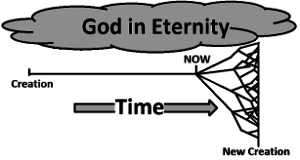
A recent conversation with a friend who conducts a weekly bible study gave me an idea for my blog: I can take an aspect of his weekly curriculum and present it here. Next week’s study will be about “eternity” which sounds, from a grammatical point of view, simplistically uninteresting but which takes on a completely different appeal when we realize that there is no biblical word for it, “eternity.”
If you look for it in a concordance, search for “for ever.” In the Old Testament, one term refers to the passing of time, the duration of time, and thus, says the dictionary, “perpetuity of time,” or in our lingo: eternity.
The fear of the LORD is pure, enduring forever. Psalms 19:9
The dictionary then references another word we interpret as eternity in the Old Testament. It is defined as “hidden time, [a] long [time], the beginning or end of which is uncertain or else not defined.” There is one word used to define both Old Testament terms: perpetuity. Thus the ancients used both words in one phrase:
The LORD is King for ever [1st word] and ever [2nd word] Psalms 10:16
What they are actually saying is, “throughout time…” One scholar reminds us:
Hebrew equivalents for eternity are temporal to the extent that they do not signify things beyond [time or eternity] but things pertaining to this life. Because our idea of eternity is religiously colored, it is advisable to avoid this term when we want to translate Hebrew equivalents into our language and to translate them by means of the notion of “boundless time.” — Hebrew Thought Compared with Greek Thorleif Bowman p. 151
This is why the word “forever” makes perfect sense to the ancients when a slave’s devotion to his master was “perpetual …forever” or throughout his lifetime. The NIV tidies this up for us by translating it “for life.” which is NOT what the Bible said but is what the Bible meant:
Then his master must take him before the judges. He shall take him to the door or the doorpost and pierce his ear with an awl. Then he will be his servant for life [Hebrew: forever]. Exodus 21:6 NIV
In the Old Testament using this word to describe a servant’s faithful lifespan makes perfect sense. Does this mean that when the angel “swore by Him [God] who lives forever…” in Daniel 12:7 that God is not eternal!?
I heard him swear by him who lives forever …. Daniel 12:7
Of course not! In every sense possible God is eternal, forever and ever… It just has to be said within the limitation of a language (Old Testament Hebrew) that, in all honesty, does not have our word “eternal.” So David explains it this way [and you can read “eternal” into his thought]
Before the mountains were born or you brought forth the whole world, from everlasting [time immemorial] to everlasting [time in perpetuity] you are God. Psalm 91:2 NIV
The grass withers and the flowers fall, but the word of our God endures [is established] forever. [God’s Word is not transitory] Isa 40:8 NIV
(God’s Word is NOT true now or then, but consistently and always true and applicable to the conduct of a holy life as long as time endures … and beyond.) Bowman notes the “The Hebrews simply think of the matter in an entirely different way.” [Page 154] And it is this difference we hope to show shortly.
The New Testament word for forever is our word eon, “age” Jude said it right:
To the only God our Savior be glory, majesty, power and authority, through Jesus Christ our Lord, before all ages, now and forevermore! [into all ages] Amen. Jude 25 NIV
This is what one scholar refers to as the “boundless Beyond,” from the ages to the ages to come, i.e. forever and ever. [Ephesians 2:7] But this is still “the aggregate of things contained in time.” [Thayer’s Dictionary]
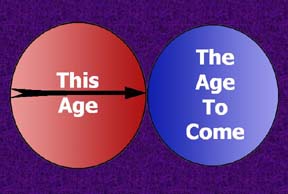
The New Testament sees two ages: the present [Galatians 1:4] and the one to come [Ephesians 2:7].
“The ages to come” becomes a metaphor for eternity, even though—think about it—we are using a term, “age,” that is bounded. In other words, it has a beginning and an end date. It makes good Greek but lousy Bible.
“Truly I tell you,” Jesus said to them, “no one who has left home or wife or brothers or sisters or parents or children for the sake of the kingdom of God will fail to receive many times as much in this age, and in the age to comeeternal life [ageless life]” Luke 18:29-30
The Greek language is not only tied to “time” – a time period, but it envisions a PERIOD of time. As such the word often in the New Testament refers to this world (38 times in the King James) and is compared to the present time. Look at another translation of Luke 18:30
…who shall not receive manifold more in this time, and in the world to come eternal life. ASV
This age to come is the same as the world to come [Mark 10:30].
The simple truth is that we have no word for the time to come. Bowman concluded, “The glory of this world is nothing compared to the glory of eternity.” [Page 155]
… as it is written: “What no eye has seen, what no ear has heard, and what no human mind has conceived”— the things God has prepared for those who love him – 1 Corinthians 2:9 NIV
Think about it: Our Bible was not written to describe heaven to us. The Bible was written to equip us for our spiritual sojourn through this life to live victoriously over sin and follow Christ. [2 Peter 1:3].
When we talk of happiness, we think of heaven, but that was not Jesus’ emphasis. His was the sermon on the mount and the “Beatitudes” which is the way to happiness in this life – in this world or age.
Look at the timeline of Scripture. We begin to read in Genesis 1:1 “In the beginning … (of time). God begins by creating time. The Bible ends in Revelation 22:5 with the removal of the sun and moon God created in Genesis 1. This marks the end of time and the beginning of …eternity. The text in between is this life …as it should be …as it must be!
When it comes to the life to come? Jesus reassuringly consoled,
“Do not let your hearts be distressed. You believe in God; trust me….” John 14:1
How can we be sure that what is eternal is really eternal?
There is another word used only 3 times in our New Testament that makes all this plain. Time is only useful as a measurement while death reigns, because time measures decay, entropy, the running down and dying of all things. So we look for a non-death or in our language: immortality.
Is God eternal then? You answer this:
God, the blessed and only Ruler, the King of kings and Lord of lords,who alone is immortal and who lives in unapproachable light, whom no one has seen or can see. To him be honor and might forever. Amen. I Timothy 6:14-15
And what about us? Is not this the glorification of the body?
…those he called, he also justified; those he justified, he also glorified. Romans 8:30
For the perishable must clothe itself with the imperishable, and the mortal with immortality.When the perishable has been clothed with the imperishable, and the mortal with immortality, then the saying that is written will come true: “Death has been swallowed up in victory.” I Corinthians 15:53-54
In our Old Testament the prophet prclaims, “He will swallow up death forever.” [Isaiah 25:8 ] We don’t need the work “forever” since when death is no more we have entered eternity.
But my favorite verse is something Jesus promised:
Jesus said to her, “I am the resurrection and the life. The one who believes in me will live, even though they die; and whoever lives by believing in me will never die.” John 11:25-26
There are many pictures of [Heaven] which imaginative church leadership might describe in sermon and song—some of these are even supported by scripture. …streets of gold [Revelation 21:21], mansions [John 14:1], a palatial and lavish table spread as a marriage feast [Revelation 19:9] for innumerable guests all wearing white [Revelation 6:11] and drinking a divine vintage [Mark 14:25]. And no one sees a time piece anywhere, neither is there any concern about time since there is no setting sun [Revelation 22:5]—the most definitive sign that we have entered eternity. A crowd gathers, an excited assembly, a worship service, a saintly choir with an angelic accompaniment [Revelation 5:9; 7:9]. In perfect unity they raise one voice to sing a new song. Perhaps, after the meal?
But these acts describe the appearance of things, a glorified body in the tireless ebullience of an eternal youthfulness, but do not envision what changes might be occasioned in the heart that might make this all possible.
We shall know then [I John 3:2] more completely the unity that the Trinity shares [John 17:22]. We have enjoyed here but a taste of the “love” that defines God Himself [I John 4:8] that will define our relationships then. Sorrow, grief, and fear will then no longer challenge our happiness [Revelation 21:4].
In this life our happiness is tied to living within the wisdom of Jesus’ sermon on the mount. Here is profound insight into our current reality that will be exchanged for that heavenly reality. Our worldview which explains suffering will be laid aside for a heaven-view without suffering. The beatitudes [Matthew 5:3-12] encapsulate sources of happiness now which will be exchanged then for an eternal joy:
Now, our happiness is tied to our relinquishing everything we have and are for His service, which Jesus goes on to explain, includes a few tears. We will then exchange this all for a tear-free inheritance in the Kingdom of God [Matthew 5:3].
Now we mourn as an expression of a deeply meaningful prayer life—essential to our happiness here, which we will exchange then for an eternal comfort [Matthew 5:4].
Now our happiness is tied to a passionate desire to sacrifice all to follow Him. We will someday inherit all things that now we have surrendered in His name [Matthew 5:5].
Now nothing gives us more joy than by faith to know Him and share in His calling [Philippians 3:10]. Then we shall know the happiness of being forever with Him [Matthew 5:6].
Now, our happiness is tied to giving, not receiving, but then we will be the beneficiaries [Matthew 5:7].
Now we eschew evil. We joyfully stand tall in the winds of trials that blow [Ephesians 6:14], but then, our lives will be defined by a happiness free from trials [Matthew 5:8].
Now we seek peace and reconciliation and forgiveness, the forerunners of all happiness here. But then, we shall share in the peaceful unity of God’s family [Matthew 5:9].
We rejoice now to share in His sufferings [Philippians 3:10] in our world. Then our happiness will be complete when we are welcomed into His [Matthew 5:10-12].
“Well done, thougood and faithful servant: thou hast been faithful over a few things, I will make thee ruler over many things: enter thou into the joy of thy lord.” Matthew 25:21
Our happiness now, in short, is tied to this world’s experience, to a worldview that makes sense to us in terms of the joy of our salvation, that includes the trials and sufferings of this life. We have learned to sing in prison [Acts 16:25]. Our happiness then will be tied not to a worldview that must include all things that oppose our serving God. Our happiness then will be a worship experience unleashed, unhindered, unchallenged. [Psalms 115:18].
Oh! The discourse of men can’t explain this! What assurance of infinite grace! Words tied to this life can’t make plain this Gloriously incomprehensible place!
We use our words in picturesque ways to dream of such happiness with only glimpses of this heaven in those few moments when love seems purest, joy near overwhelming, or those moments during worship when our unity is characterized by an unconditional acceptance of each other that is blind to race, ethnicity, gender, class [Galatians 3:28], for that matter, any condition real or imagined that might separate us.
Our worship of God is the key to our happiness. We get but a glimpse here of what will be a way of life there. Our worshipping God is a complete expression of who we are. Worshipping God is the ultimate expression of our unity in which each believer finds self-expression and complete self-fulfillment. Acting in God’s interests serves our own. Heaven becomes the place where our interest is to serve Him.
Our relationship with God in His world is more than symbiotic. We do not do for God so He will do for us. Worship then will be as natural and as “us” as breathing is now. It might be best explained in 7 words:
Acting in God’s interests serves our own.
Our happiness feeds off worshipping God. In heaven love will be mutual, shared—no longer misunderstood, no longer expressed with faulty or clumsy miscues, no longer unrequited. Zephaniah was given a glimpse of our coming happiness….
Zephaniah 3:13; 19-20
No violence rages in their eyes And no deceit upon their tongue No more guile and no more lies. A song of praise and worship sung. Like precious lambs in pastures graze Which lie contented all their days No longer will they be dismayed In safety they are unafraid.
His word fulfilled for all who roam To gather them and bring them home.
All peoples, let us praise our Lord For freedom now has been restored.
“…words often contain a witness for great moral truths—God having impressed such a seal of truth upon language, that men are continually uttering deeper things than they know…” Richard C. Trench. On the Study of the Words Lectures.
To Pray
And every African tribal language that I came to know of, the concept “to pray”was translated simply as “to ask for.” That really doesn’t cover the full dimension of prayer at all especially not Christian prayer. [Donovan Vincent J., Christianity Rediscovered. p. 99]
On Truth
As Mark Twain allegedly quipped, “It is not what I don’t know about the Bible that bothers me; it is what I know.”

 Here’s the interesting part in all this: There is a biblical word for this as if God were choreographing some ceremonial expression designed exclusively to honor Him. After all the scripture affirms: God inhabits the “praises” of His people [Psalms 22:3] … and (ready for this?!) the verb in the Old Testament for praise comes from the word “hand” and means—among other related nuances—to show or point out with the hand extended, to celebrate and give thanks [an exclamation point …or two… belongs here]!!
 Oh yes, Pentecostals often instruct their parishioners to raise their hands in worship but no one is telling the Baptists or Presbyterians or Catholics to do this. I think they wouldn’t dare because such a free flow of expression might not be as natural in these services where the order of the ritual is—I say lovingly—by design, more a part of the worship.
 The point of this very human story is being missed by these two exegetical extremes, because the real story traces the emotional turmoil of a prophet who had every sign of PTSD.2 The account, using a Hebrew word for “evil,” simply says that Jonah was heavily distressed, overwhelmingly miserable, and enraged.
 A recent conversation with a friend who conducts a weekly bible study gave me an idea for my blog: I can take an aspect of his weekly curriculum and present it here. Next week’s study will be about “eternity” which sounds, from a grammatical point of view, simplistically uninteresting but which takes on a completely different appeal when we realize that there is no biblical word for it, “eternity.”
 This is why the word “forever” makes perfect sense to the ancients when a slave’s devotion to his master was “perpetual …forever” or throughout his lifetime. The NIV tidies this up for us by translating it “for life.” which is NOT what the Bible said but is what the Bible meant:
 This is what one scholar refers to as the “boundless Beyond,” from the ages to the ages to come, i.e. forever and ever. [Ephesians 2:7] But this is still “the aggregate of things contained in time.” [Thayer’s Dictionary]
 When we talk of happiness, we think of heaven, but that was not Jesus’ emphasis. His was the sermon on the mount and the “Beatitudes” which is the way to happiness in this life – in this world or age.
 We use our words in picturesque ways to dream of such happiness with only glimpses of this heaven in those few moments when love seems purest, joy near overwhelming, or those moments during worship when our unity is characterized by an unconditional acceptance of each other that is blind to race, ethnicity, gender, class [Galatians 3:28], for that matter, any condition real or imagined that might separate us.